Market vs Limit Orders: Which Should You Use?
Market and limit orders are the two building blocks of almost every crypto trade. One prioritizes speed, the other prioritizes price. Understanding the trade-off between them is one of the first practical skills any new trader can build.
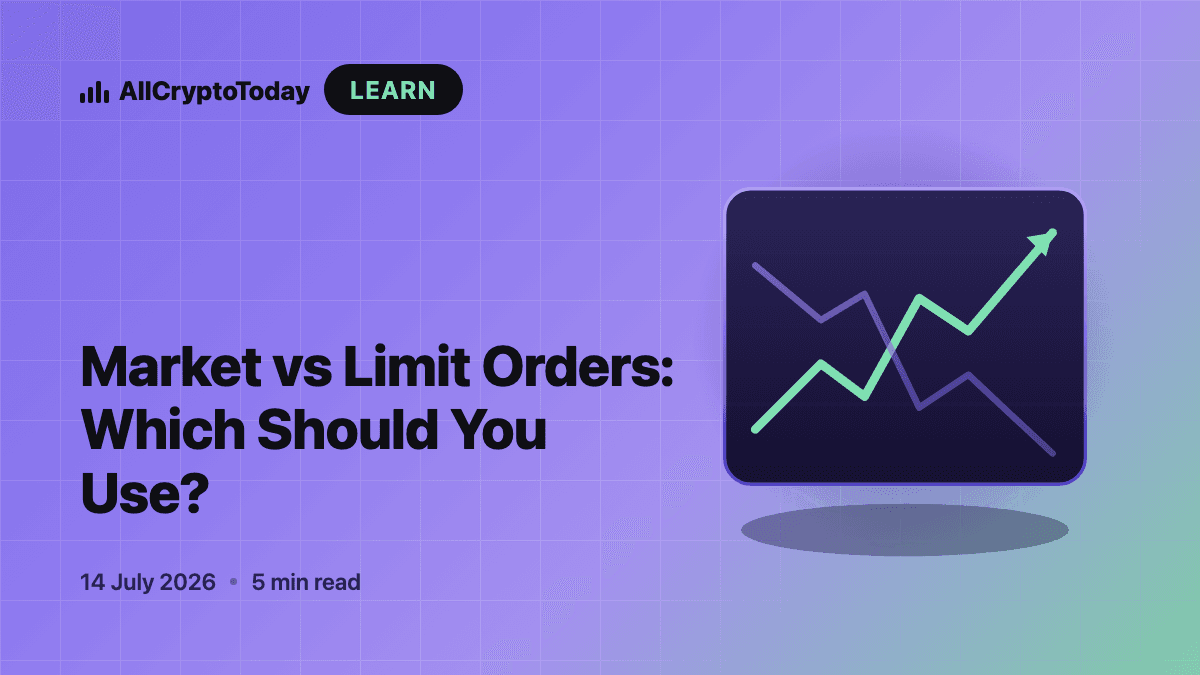
When you place a trade on a crypto exchange, you are usually choosing between two basic order types: a market order or a limit order. They sound technical, but the difference comes down to a simple question — do you care more about getting filled quickly, or about getting a specific price? Learning how each one behaves helps you avoid surprises and trade with more intention.
What a market order does
A market order tells the exchange to buy or sell immediately at the best price currently available. Speed is its main advantage. If you want to enter or exit a position right now — say, to buy BTC before you think it moves — a market order gets the job done in seconds.
The trade-off is price uncertainty. You accept whatever prices the order book offers until your order is fully filled. In calm, liquid markets the difference is tiny. In fast-moving or thin markets, though, your average fill price can drift away from what you saw a moment earlier.
Slippage in plain terms
That drift is called slippage. It happens when there isn't enough volume at the best price to fill your whole order, so it "walks" through worse prices. Analysts often note that slippage grows with order size and shrinks with market depth. For small trades in major pairs like ETH, it is usually minor; for large orders in low-liquidity tokens, it can be significant.
What a limit order does
A limit order lets you name your price. You set the maximum you're willing to pay (for a buy) or the minimum you'll accept (for a sell), and the order only executes at that price or better. This gives you control, but no guarantee — if the market never reaches your price, the order simply waits, and may never fill.
Limit orders are also the tool most traders use to be patient. You can place a buy below the current price hoping for a dip, or a sell above it hoping for a rally, then step away.
A market order asks the market for a fill, while a limit order asks the market for a price — and you rarely get both at once.
Choosing between them
There's no universally "correct" choice; it depends on your goal for that specific trade.
When speed matters more
Reach for a market order when execution certainty is the priority — exiting a position quickly, or entering during a window you don't want to miss. Just be mindful of slippage in volatile conditions.
When price matters more
Reach for a limit order when you have a target price and can afford to wait. It's well suited to disciplined entries, taking profit at a set level, or trading less liquid assets where a market order might slip badly. Many exchanges also charge lower "maker" fees when your limit order adds liquidity to the book, which reports suggest can modestly reduce costs over time.
A quick note: none of this is investment advice. Order types are tools, not strategies, and the right one depends on your own plan and risk tolerance.
Key takeaways
- A market order prioritizes speed and fills immediately, but the exact price is not guaranteed.
- A limit order prioritizes price and only fills at your chosen level or better, but it may never execute.
- Slippage tends to grow with larger orders and thinner liquidity, so size and market depth matter.
- Use market orders when getting filled is urgent; use limit orders when hitting a target price is more important.
- Neither is inherently better — match the order type to the goal of each individual trade.
DISCLAIMER
All the content on this site should not be considered investment advice. Investing is speculative. When investing your capital is at risk.

Senior Markets Reporter
Arijit covers crypto markets, on-chain data and macro trends. He has written about digital assets since 2018 and focuses on turning complex market moves into clear reporting.